Saturday, December 03, 2005

Paper Doll: A Study in Red

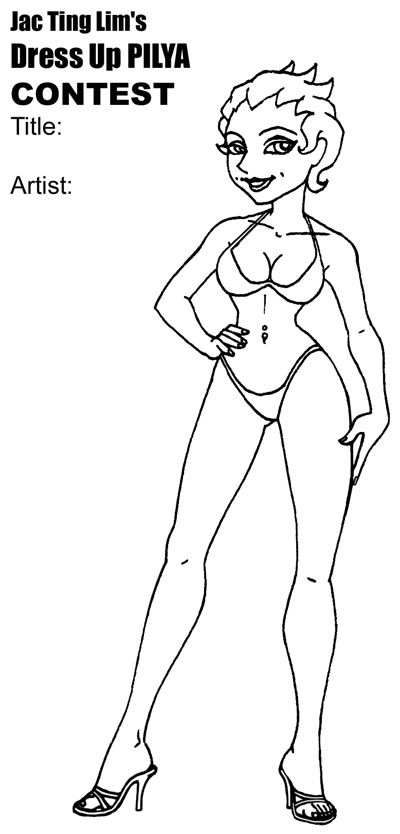
There's an interesting contest up at Jac's blog for this month, and, well, let's just say that it falls somewhere in the realm of the unexpected:

Image hosted by Photobucket.com
Starting NOW I'm holding a Dress Up PILYA contest! Just download this art here and design something for her to wear (like a paper doll?) this Christmas.

I'll award the best design a free, one of a kind, PILYA t-shirt!!! Custom-made for the winner!

Geez... she's a well-formed woman, isn't she? :)

I can live without the prize, mind you -- I can't remember the last time I pulled on a t-shirt -- but the prospect of dressing up somebody else's creation felt too good to resist.

A lot of people know that I write, but not many people know that I can draw to a certain degree. My skills aren't along the lines of the typical comics artist, but I think I can run a pencil along paper and not embarrass myself too much. Every now and then, when I have ideas that don't seem to be appropriate enough to write, I put my conceptualizations down on a small sketch pad; I find that this approach has helped me visualize more than a few characters over the last few years.

In addition to that, I still retain many of my skills in Adobe Photoshop (as evidenced in an earlier blog post,"The Resurrection of Dame Elemen"), and I think I can probably edit images with the best of 'em. Throw in a passing interest in fashion design, and you have a scenario that's about as made-to-order as you can probably get.

I never expected to end up playing with paper dolls in this way, but I figured that the opportunity was too good to miss. Since then, I've sat at my computer in bouts of two or three hours each, doing nothing but work with lines and paths.

Usually, when dressing a character, I first ask myself who the character is and what impression she is likely to give people. From there, I move to personality and motivation. General looks, combination and color come last. I'm of the opinion that clothes (or armor or such) should be at least vaguely functional as well as practical, and I'm unlikely to have a character wear anything on impulse.

I don't know much about Jac's character here, although I do know that she has no name at the moment. For the sake of this article, let's call her "Ada". (I don't know why; These names just pop into in my head for some reason.)

In the Pilya strips that Jac has posted, I believe that Ada has given people the impression that she's the extroverted, outgoing type. She wears a lot of revealing clothes, has one of the most unsubtle of jobs (she once appeared in a Playboy-bunny-type outfit as the "entertainment" for a bachelor party), and tends to say things that people don't expect. I feel almost certain that, if she would wear anything, it wouldn't leave much to the (male) imagination.

With regards to personality, Ada seems like a fun-loving, take-life-as-it-comes-along kind of person. She's forgetful at times. She can easily be seductive when she wants to. She appears to have an active sex life. She speaks her mind, often saying things without thinking about them first (or perhaps she simply says these things just to see what reaction she gets). She dresses in much the same way, I think -- what kind of person would wear an extremely short, revealing gothic dress to a wedding?

On the looks side, I've had to take note of quite a few elements: Ada has reddish-brown hair. Ada has some really beautiful green eyes. Ada has a mole on her lower right chin. And, as I realized with the "model" picture above, Ada has a pierced navel and really long legs.

Given these inferences, what would Ada probably wear for Christmas?

The first thing I concluded was: "She'd probably vamp it up."

I wanted Ada to wear something respectable for Christmas, so I thought of a sport jacket -- I feel that it's a nice, sensible formal outfit. I wanted it to be red, to go with the color of her hair and possibly accentuate her green eyes. I thought of a red sport jacket and black pants, and the image appeared to fit her.

The problem, of course, is that Ada doesn't quite act the part of a quiet, respectable woman. In fact, I would imagine that she walks into a room and becomes the absolute center of attention there. The amount of exposed skin would probably have something to do with that. Ada would wear the red sport jacket, but she'd wear it in such a way as to leave little to the imagination.

The solution, I think, was easy: Increase the cleavage, and remove any notion of a bra. That's non-subtlety for you.

After a few studies, I figured that the neck and upper chest area looked a little bare (yes, that was the point, but still...), so I debated adding something there. The blue pendant was a final touch, but I was uncertain as to whether or not Ada would be the type of person who would wear one with such an outfit. I still have the original raw file with me, however, so I suppose I can make a few changes if needed.

In any event, this is what I ended up with:

Image hosted by Photobucket.com


Personally, I like how it turned out. The clothes seem to blend in well with the vestiges of the original drawing. I figure that I can probably do better, though, and that's why I'm watching the Lifestyle channel, sifting through fashion magazines and Calvin Klein ads, and generally sitting at the computer for periods of two or three hours again.

If I do come up with anything else, I'll see if I can post it up here. This is an oddly compelling exercise...

Thursday, December 01, 2005

Disclaimer: December 2005

No, I think that this blog has a long way to go before it can be considered a good source of reading. It has its hits right now, but it's still got its misses.

It may not be immediately obvious, but writing original blog entries isn't exactly an effortless endeavor. I perform bits of research, spend hours selecting the right words, and proofread everything just to present each article to an audience who may or may not appreciate it. I even go as far as to assure people that everything here is original except where noted, and I'll always cite external sources wherever they lie.

Just because a certain article on this blog fits your personal taste, assignment, project or thesis perfectly doesn't mean that you can automatically use it. These writings are wide open for public consumption, but there's a big difference between reading something and appropriating it for your own use. Big, big difference there.

Now, if you would take the time to just ask, then that would be a lot better. I like people who have enough sense to ask permission; A lot of people do, I think. You're likely to get what you want that way, and all it'll require is a small amount of your patience.

If you decide to just up and steal my stuff, though, then that's when I'd start shaking my head and muttering the occasional silent epithet. I feel that each and every man has the capability to produce their own completely original masterpieces in one way or another. By choosing to just take other people's stuff as opposed to creating them on your own, you indicate that you're too darn lazy to achieve your own little bit of greatness.

That makes me sad. It's a sad, sad, sad situation there. Why ya gotta do dis ta yousself, Johnny? You know I've been real good to ya.

Of course, after the moment of sadness passes, then that's when I go to the corner and grab my baseball bat. If you're going to steal something from here and pass it off as your own work, after all, then you might as well have every single drop of blood, toil, tears and sweat that I put into it. And believe me, I'm going to thoroughly enjoy giving you every last bit.

That, and it would make for a nice story, too.

Ain't violence sexy sometimes?

Wednesday, November 30, 2005

In Multiples


Anyone out there know what the plural of "suman" is?

"Sumans"? "Sumen"? "Sumani"?

I really hate linguistic dilemmas like this. You'd expect there to be a simple rule governing this aspect of the English language (despite the fact that "suman" is a Tagalog word), as opposed to having to waste precious time debating plural forms.

The normal rule for plurals involves adding an "s" to the end of the word: One computer, two computers. One composition, two compositions. One Sean, two Seans.

The normal rule doesn't make sense, however, when it comes to words that already end in an "s". So the English language has an exception to the basic rule, in that pluralizing such a word requires an "es" instead: One dress, two dresses. One sinus, two sinuses. One sassafrass, two sassafrasses.

Then there's another exception: What about words that end in a "y"? By some strange linguistic quality, we convinced ourselves that anything ending in a "y" could be pluralized by removing the offending letter and tacking on an "ies": One symphony, two symphonies. One parity, two parities. One pigsty, two pigsties.

But then, heaven forbid that we fall into the use of the word "monkeies". That third rule therefore has an addendum, and it states that any word that ends in "(vowel)+y" only needs to have an "s" added to the end: One monkey, two monkeys. One foray, two forays. One Bed-Stuy, Two Bed-Stuys.

Oh, no... you're not getting away that easy. Sit down; I'm not done yet.

There's the question of words that end in an "o", for which there seems to be no general distinction between "s" and "es" usages. Instead, we've seen fit to let the plural forms of these words run amuck: One zoo, two zoos. One hero, two heroes. One tornado, two tornados/tornadoes (either will do, yes).

The short list of words ending in "f" or "fe", for that matter, haven't been spared: One dwarf, two dwarves. One life, two lives. One staff, two staves. However, some words still buck this aspect of English linguistic law: One handkerchief, two handkerchiefs.

Then, there just to push us even closer to the brink of madness, I must bring up the exceptional exceptions: One man, two men. (One can, two cen?) One mouse, two mice. (One house, two hice?) One ox, two oxen. (One strongbox, two strongboxen?)

There are also a number of advanced English words that seem to follow their own set of customized rules for plurality. I used to believe that anything ending in "us", for example, could be pluralized by changing the last two letters to "i": One radius, two radii. One stimulus, two stimuli. One homunculus, two homunculi. Then I ran into one of the many words found in every technical person's vocabulary: One virus, two viruses.

Still reading? Good.

There are other words that are more well-known for their plural than their singular forms, and these are a source of frustration for me. Did you know, for example, that anything that ends in "um" gets pluralized by replacing the last two letters with "a"? I do now, and I can't say it's a favorite: One datum, two data. One arcanum, two arcana. This even has a significant number of exceptions on its own: One cranium, two craniums. One mum, two mums. Heck, sometimes we can't even make up our own minds: One symposium, two symposia/symposiums.

There's another rule that anything ending in "(vowel)+x" can be pluralized by cutting off the last two letters and appending "ices": One matrix, two matrices. One index, two indices. And yet we somehow still find a way to assure ourselves of the need for exception here: One sex, two sexes.

There's a rule that anything ending in "is" has to have the ending changed to "es": One parenthesis, two parentheses. Again, however, an exception: One ibis, two ibises.

Anything ending in "a" can be pluralized by adding an "e" to the end: One antenna, two antennae. And yet we're familiar with: One idea, two ideas.

Sometimes we run into words that are so obscure that their plurals (or associated singulars) never come up in normal conversation: One grafitto, two grafitti. One seraph, two seraphim. One coccyx, two coccyges. One die, two dice.

Then there are the words that stay exactly the same in both forms: One sheep, two sheep, three sheep, four sheep, five sheep, six.

And now, having gone through three years' worth of grammar lessons in one sitting, we still have no solution for our original dilemma: One suman, two... er... what?

Sometimes I fear for the English language. Sometimes I even wonder how so many people from so many other places can find some way to become adept enough at its use to speak or write for a living. Looking at everything right now, I feel it's kind of obvious that the language is more screwed up than we think.

So what's the plural of suman? I don't know. I'll probably just go back to using "one piece of suman, two pieces of suman". At least that doesn't necessitate the oncoming headache.

Now if I only knew what to do with the word "equipment". One equipment, two...


Tuesday, November 29, 2005

Deadlined

Three times a year, the crushing weight of deadlines imposes itself upon my office, generally rolling over everything in its path and turning our best efforts into mush. Three times a year, we enter "business hell", which happens to be our affectionate name for the weeks upon weeks of insane pressure, endless coding and unpaid overtime.

December is the most obvious of those times, and for good reason. At the end of each year, everyone's expected to produce their strategies and offerings for the next 365 days. Because I happen to work as a manager in a web development firm, this usually means that I end up minding not only our own end-of-year concerns, but our clients' as well.

I've actually got a strange brew of projects on my desk at the moment: There's an electronics manufacturer there as well as a royalty-sourced insurance company, a religious sect, an oil and gas magnate, two grassroots software firms and even the odd French businessman. All of them have one thing in common, and it's the fact that they're all breathing down my neck.

I suppose that, in exchange for this kind of pressure, our employers usually ply us with the usual Christmas "gifts": assorted giveaways, a fat salary bonus, and an end-of-year party that everybody attends for fear of offending their respective bosses. My company usually stuffs us with the first two items sometime in the tail end of November; I suspect that it's so that we can't complain about the extra workload next month.

Personally, I just want some extra sleep. This is probably one of the few times of the year where I won't complain about the occasional holiday.

By some strange combination of factors, I find myself almost fully booked for the next month. I'm helping to run a bazaar* this weekend, I'm dropping by a book launch next Saturday, and in the intervening days I'll be expected to greet, converse with, and kowtow to a number of visiting relatives. That's the holiday season for you, I think.

It almost makes you want to strip down to your underwear and run screaming through the streets.

...

I'm not going to do it, mind you, but you're perfectly welcome to do so.

Hey, it's not as though I'm the only person who's trudging through the swamp of holidays. I figure that you're probably going through the same thing, and it does my heart glad to know that we're all in this together.

Er... we are, right?

...

Hello?

...

...

Ah, fine. You're all lazy bums, anyway.

See if I care when you find yourself sitting in a tub of jello and gift-wrapping paper, holding a rubber gun to the head of a plastic Santa toy and screaming "Don't eat the gingerbread! Don't eat the gingerbread!"

Then again, if that ever happens, I'll probably be there holding the camera.

Where was I again?

...


* That's the Xavier School Wish Bazaar, taking place at Xavier School in San Juan, Metro Manila on December 3 and 4, 2005. Do drop by -- there's going to be an Adidas warehouse sale (minus the warehouse, of course), a peewee basketball game (you ain't seen nothing till you've seen a bunch of three-year-olds mount a decent offense), and some weird oik sitting at the gaming tables (the only man in the world who loses badly at Pokémon -- that's me). Just remember not to feed the animals (me again), and you'll be fine.

Thursday, November 24, 2005

Yes, But is it Good?

By some nasty quirk of fate, my college blockmates were able to find out that one of my short stories will be appearing in Dean Alfar's 1st Philippine Speculative Fiction Anthology. True to form, they wheedled me to the point where I couldn't really lie about the whole thing:

It's getting launched on December 10, actually. It's one of the three books getting released in a 6:30 affair at Fully Booked in Greenhills.

You're welcome to pass by, although I'd recommend just buying the book and telling me whether you liked the story or not. :)

Consequently, one of the responses I received from the mailing list went as follows:

I might not be able to pass by on December 10. But I will try to pick up the book when I come across it. I'm sure the story is good. You wouldn't allow it to get published if it wasn't.

*Sigh*

I can't help but think that that's more than a little optimistic.

That's not to say that I don't appreciate the gesture. In fact, I do appreciate it, and I'm happy to see that my writing actually does get a bit of support in some quarters.

But that's where the hitch comes in: I don't know if the story's good or not.

It might sound strange, yes, but that's how I look at it: I don't know if the story's good or not. Ergo, I may or may not believe that it's good enough to get published. All that matters to me is that I was able to write the silly thing, and if somebody out there thinks that it's good enough to print, then so much the better: I get access to more people who can tell me what they think.

But to say that it's in the anthology because I thought that it was good enough to go into the anthology? Absolute hooey. When Dean Alfar's deadline came about, it was the only five-thousand word story I had that contained the slightest bit of redeemability. I believe that that's the only reason why I sent it in when I did.

I hoped that it would make it, of course. You don't submit works like these without some sliver of expectation that they might make it to the final volume. But if I were to tell you that I thought it was an incredible piece of work to begin with, then I'd be lying.

I think that we all eventually have to face a certain truth: No matter how good we think our writings are, our opinion doesn't mean squat when it comes to the tastes of the general public. We can have what we think is the greatest plotline in the world, the best characters ever conceived and the most profound setting that can ever be imagined, and that still won't protect us from the erstwhile critics who accuse us of being "cliché", "wordy", "simple", or even the inevitable "boring".

We just write, darn it. We write, we turn in our works, and we wait for a response. If by some miracle it turns out that our stuff is worthy of being published, then that doesn't mean that we're good. It means that we just happened to do something right.

Writing, unfortunately, isn't a matter of thinking that you're good at this sort of thing. Writing is a constant struggle: You don't merely want one of your works to get published and praised, you want a whole slew of your works getting published and praised. You want a straight string of hits. You want to know what makes your style readable. You want to know how to get into the groove and stay there.

The big guns -- the authors and artists we all know, love and admire -- all probably know this. They may have six or seven straight bestsellers, Academy awards or platinum records to their name, but if their next work tanks, then it tanks. It's JRR Tolkien's The Silmarillion. It's Halle Berry's Catwoman. It's Michael Jackson's Invincible.

We just write, ladies and gentlemen. That, I believe, is the truth at its core.

We write, and of course, we anxiously wait -- to see what the audience thinks of us this time.


Wednesday, November 23, 2005

By the Numbers


27 - Total posts for the Suman Latik webring on this blog. (Counting this one.)

11 - Highest number of comments for a Suman post on this blog.

55 - Verses in The Book of Suman. (All with their corresponding superscripts.)

199 - Number of days since Dean Alfar's "Suman Latik" comment at the 1st Philippine iBlog Summit, the event that indirectly touched off these writings.

3 - Pieces of suman actually consumed by Sean since May 2005.

16,829 - Total words in all Suman posts combined.

53 - Total number of times the word "blah" has appeared in a Suman post.

2 - Average number of hours it takes for Sean to write a Suman Latik post.

4 - Number of people who have asked Sean "What's with the suman?" since May 2005.

4 - Number of times Sean has had to stifle a tasteless response to the question "What's with the suman?" since May 2005.

3 - Number of times Sean has pledged to give up writing about suman.

0 - Number of times Sean has missed a regular weekly Suman post. (I was following the appropriate timezones in the US, yes.)

0 - Number of monkeys Sean owns. (He does, however, own one typewriter.)


Tuesday, November 22, 2005

Fear of God

"Happy are those who fear the Lord."

I was attending a wedding last Saturday afternoon when the above responsorial psalm took me aback. It's not an altogether nice combination of words; I mean, when was the last time you saw both "happy" and "fear" in the same sentence?

I don't have a good relationship with organized religion. I think it's because I keep asking questions that never receive any solid answers. Almost every religious discussion in which I've been involved has turned out unsatisfying for all parties: I end up unsatisfied because I don't get any responses that justify the common aspects of modern faith, and my fellow conversationalists end up unsatisfied because they can't seem to supplement my understanding. Or, failing that, they usually seem to get angry at me, which I find to be a very un-Christian way of dealing with things.

With that background out of the way, you can probably see why I felt that the above phrase was more than a little disconcerting. Doesn't the emotion of fear imply feelings of apprehension, dread, and anxiousness? If so, how is it possible for a man to be happy at a point where he still fears an certain entity? And if we proceed along this line of thought, is it therefore appropriate that Christians feel terror at the presence of God?

Yes, this most definitely does not sound right.

I'm aware of a lot of literal definitions of the "fear" of God, and none of the connotations are good. Conversion by the sword, for example, was common in the Middle Ages: You either converted to the Christian faith, or you were killed. The Spanish Inquisition instilled a fear of torture in the free-thinking masses, under the guise of rooting out the heretic and the seditious. Even now, there are more than a few modern Christians who threaten that you will go to hell if you go against the local religious or moral practices. There are all too many incidences where "the fear of God" often translates into "the fear of pain", or "the fear of rebuke".

This feels wrong somehow. I don't want to be afraid of God, after all; It implies that he's looking to harm me in some way.

Let me consider, then: I am aware of God. I am aware of God's presence. I believe in his kindness and benevolence, and I believe that he sent his son to die for our sins (unconditionally the heaviest of all sacrifices). I believe that God is just and forgiving, that he sees what lies in each and every one of our hearts, and that on a great and final day, he will return for the last of the people worthy enough to enter his kingdom of heaven. I believe that the Bible houses the word of God, and that its writings were created by the divine source through human authors. And as a Roman Catholic: I stand by the institution of the church, I hold faith in the sacraments, and I trust in the infallibility of the Pope.

If anything, I hold respect for God. I'm refuse to be afraid of him as the pagan communities once were before sword-wielding crusaders, as philosophers and theologians were before the knives of Torquemada, or as little children before a well-meaning but misunderstanding parent. That would imply that I believe in God out of a mere desire to save my own skin. I don't.

So why, then, do we have such a concept as "God-fearing"?

Webster defines fear as "an unpleasant often strong emotion caused by anticipation or awareness of danger", and I'm not surprised there. I mean, it conveniently covers what we've discussed so far.

Interestingly enough, however, Webster also defines fear as "profound reverence and awe especially toward God", a definition that is echoed in a number of Catholic dictionaries as well. So there is a way to interpret the "God-fearing" concept without bringing to mind images of terror and subjugation, it seems.

The second definition also makes sense: God may not necessarily inspire feelings of terror in us, but I figure that God most definitely inspires feelings of reverence in his corresponding believers. We don't fear God in the sense that he frightens the heck out of us; We fear God in the sense that he is an omnipotent, omniscient entity. In this way, I think, the act of fearing God implies an acknowledgement of his incredible self, which is a far cry from seeing him as a spiritual bully.

The whole discussion, however, still makes me wonder why so many people continue to utilize God as a threat. Preachers still throw fire and brimstone from their pulpits. Fundamentalists attack other religions in the name of faith. We even get snatches of it in the common vernacular: "Go to Hell!" and "May God strike me down!" are two of the more familiar phrases.

Does the prospect of going to hell scare us? Perhaps. It doesn't take a genius to see what's scary about the possibility of drowning in a lake of fire for the rest of eternity. (And that's only one of the many different interpretations of hell, to boot.)

But does the threat of going to hell justify placing one's faith in God? I kind of doubt that. If the man-on-the-street tells me that God is going to send me to hell because I don't go to church on Sundays, then I'll be more likely to strike back at him than listen. Actions like that hurt faith in a lot of ways.

Happy are those who fear the Lord? I don't think so. Any man who is instilled with the terror of God gives me the impression of a cornered animal, ready to lash out at anybody and everybody.

I think that the responsorial was supposed to be "Happy are those who fear in the Lord", which drives home the point of reverence and awe that the phrase is supposed to express. Any believer who holds the fact that God is all-encompassing, that God is at his side for every hour of every day, is obviously happy. We bask in the glory of God; we don't cower at his iron-fisted might.

What a difference a word makes, eh?

Thursday, November 17, 2005

One Wednesday Evening

Image hosted by Photobucket.com

Image hosted by Photobucket.com

Image hosted by Photobucket.com

Image hosted by Photobucket.com

Image hosted by Photobucket.com

Image hosted by Photobucket.com

Image hosted by Photobucket.com

Image hosted by Photobucket.com


The lesson for today, kids? Don't leave the digital camera lying around the house.

:)

Wednesday, November 16, 2005

The Approach


In response to Clair's article last week about searching for a feasible suman story idea, I posted the following:

A good start might involve determining exactly what part you want suman to play in the final product. Do you want it as background filler, for example? Do you want the main characters to mull over a plate of it? Do you want the suman to be the main character itself?

From there, you just ask yourself “Why?” and then come up with a reason. Why would two men meet in a darkened restaurant with a plate of suman between the two of them? Why would suman be banned during a specific barrio fiesta? Why would an uncle bring a basket of suman to a small family gathering?

Once you have the initial scene and setting firmly in place, you can then ask yourself “What happens?”, and finally kick the story into gear…

About two-and-a-half hours later, my comment elicited the following response from Raichu:

if that were the case, the suman becomes nothing more than a stage prop. if that’s what you really wanted, go for it.

Yes, he's right. A little blunt, yes, but I believe he's right.

I am aware that there's a danger of relegating the suman element to nothing more than a prop. However, I feel that it is also possible to emphasize the suman element in a story to a degree that it becomes much more than a prop. That's how suman stories come into being, after all.

In these situations, I tend to subscribe to a "Why?" approach because it forces me to answer a lot of questions regarding character, scenery and background. Asking oneself the "Why?" question, I think, forces the mind to work by conjuring a logical setup for the given scene. Whether or not suman figures prominently into the setup is a matter left to the author herself.

It all depends on the approach, and I figure that it might be best if I clarified that here.

Let's take that first scene posted above: Two men meet in a darkened restaurant with a plate of suman between them. There are a lot of questions that can be asked, given that scenario alone.

The more obvious ones:
- Why are they in a restaurant?
- Why is the restaurant dark?
- Why are they sharing a plate of suman?

The less obvious ones:
- Who are these two men?
- What are they talking about?
- What's the name of the restaurant?
- Where is the restaurant located?
- When does their meeting take place?

The really less obvious ones:
- What do the men do for a living?
- What relationship do the two men have to each other?
- Do they even know each other?
- What are they wearing?
- Are they both male?
- Are they human?
- Did they order the suman from the restaurant?
- Do they want to eat the suman?
- Is the restaurant operational?
- Are they waiting for anyone?
- Is it night?
- Is this all just a dream?

There are a lot of questions to answer, yes. And any one of them can trigger a story.

Let's take one at random, then: Where is the restaurant located?

Strangely, the first thing that comes to my mind here is "Berlin":

"And you zay," Gerhardt said, "that zis is a food in your country?"

"Yeah," Benedict answered. "We usually have it in December."

"Because it's cold zere?"

Benedict scratched his head. "No... we don't have winter in the Philippines. I don't know why we have it a lot every Christmas, actually. We just always have."

"Ja, ja," Gerhardt said, turning to explain something to the couple seated across from them. After a short conversation, he raised one hand and pointed at the tiny piece of suman.

"Rice... and, ah... coconut zauce?" Gerhardt said, finding the word unfamiliar.

One might as well answer any one of the questions in this way.

Is it night? No -- maybe it's daytime, and the open-air restaurant is dark because generations of air pollution have finally blotted out the sun's light. The two men are Philippine scientists discussing their proposal to reverse the process. They're digging into a plate of suman, a rarity in their time because most of the world's crops are already in the process of dying out.

Do they want to eat the suman? No -- the suman is laced with a deadly poison. The two men, who are government investigators, are just there to inspect the product, which was provided to them by one of their toxicologist partners. Two days earlier, an entire shipment of the same suman was responsible for over a hundred cases of severe food poisoning in what was termed the largest product-tampering case in the Philippines. The two men must locate the source of the poisoned suman before the perpetrators strike again.

Now, then: Which of the above three scenarios best exemplifies a suman story?

The first one -- Suman in Berlin -- looks reasonable. We find a character named Benedict, after all, in the middle of explaining the concept of suman to Gerhardt, his German acquaintance. If Benedict and Gerhardt manage to hold on to their topic for an entire narrative, then I'll argue that that would constitute a suman story. If they eventually move on to other things -- Benedict's tenure in Berlin, Gerhardt's love for horticulture, the nuances of German-Filipino translation -- then the suman becomes nothing more than a minor background element.

The second one -- The Lost Sun -- doesn't feel like a suman story at first glance. After all, it appears to focus more on the struggle to regain the sun's light through technological means, as well as the human factor involved. But we haven't heard (or told) the whole story yet. For all we know, the plate of suman in front of them becomes a factor. Maybe suman becomes essential to the scientists' proposal in some way. Maybe the suman becomes an important piece of symbolism for the story itself. We can't necessarily dismiss the fact that their suman automatically becomes a mere stage prop here.

And now, I believe we can see that the third one -- Poisoned Suman -- can probably go both ways. The investigators could follow a trail of suman poisonings all the way to a criminal who has an unhealthy fixation with the glutinous rice snack. Or the suman could just as well be an incidental -- the perpetrator has a lot of other foods at his disposal, after all.

It all depends on the approach.

There are many questions you can ask, based on a given scene. If you want to write a story where your little piece of suman won't be nothing more than a stage prop, then you just have to look at the right questions. You just have to give the right answers and follow the right directions.

Yes, it's not as easy as it looks. No one ever said that conceptualization and writing were easy.

If you want to write a suman story, you've got to do things just right. But exactly how you will go about doing it will be up to you.


In brightest day.

Monday, November 14, 2005

Antaria: Idle Conversation

Lorelei simply sidled up to the doors of the Wyrm's Roar tavern and opened them. She had to admit to herself that she expected a lot more resistance from the denizens of the place.

The inside of the tavern was cavernous in nature. Thick wooden beams stretched across a vaulted ceiling that was fully twenty feet above the wooden floors. A long counter occupied one wall of the building, while a riot of tables and chairs filled the rest. Lorelei counted three passageways other than her entrance: One was behind the barman's counter, while the other two most likely led to private quarters for the establishment's occasional guests. Mounted on the farthest wall, just above the fireplace, were the head and foreclaws of a raging dragon -- stuffed, for the pleasure of the tavern's inhabitants.

For a single moment, virtually all sound in the tavern ceased. Lorelei felt a roomful of eyes staring at her, predicting her moves.

She placed one well-clad foot beyond the threshold, and watched as the tavern returned to a sense of uneasy normality. The apron-clad man behind the counter still kept both eyes on her, however, and she smiled. She was going to ask him first, anyway.

Lorelei gracefully moved towards him, balancing the suspicious glances of the men around her with a seductive walk of her own. There were more than a few unoccupied seats at the counter, and she took the one nearest the stout barman.

"Hello," she said, batting her eyelashes at him.

"Good afternoon," the barman said, placing one arm on the counter. "What'll you have?"

"I wasn't thinking about having anything, really," she said, smiling. "Will you throw me out if I don't?"

"No," the barman said, "but if you have no business here, then you might as well get out, yourself."

Lorelei laughed. It had been a long time since she had experienced such earnestness.

"So this is the famed Wyrm's Roar tavern," she said, "home of thieves, cutthroats, and mercenaries."

"I abide few thieves and cutthroats in my tavern," the barman said, "but the last is true. You have your pick of hired hands here."

Lorelei scanned the crowd. "Mm, yes... your people have a certain look about them."

The barman scowled at her. "Do you have a job that needs doing, my lady?"

"I'm just looking for someone, that's all."

"Well, if he's here," the barman said, relaxing a little, "then I can get him for you. If he's not, then you can leave a message for me to deliver the next time he passes by. Who do you want, my lady?"

"I'm looking for Auros," Lorelei said.

The barman froze noticeably at the mention of the name. Out of the corner of her eye, Lorelei spotted two burly men casting glances in her direction.

The barman cleared his throat and leaned forward. "Auros isn't here," he said. "What do you want with him?"

Lorelei paused, her expression shifting into a serious look. "Not what you may think," she said, gazing intently into his eyes.

"Not what I may think?"

"Personal business," Lorelei said. "Now let go of the weapon."

The barman raised an eyebrow. After a few seconds, he removed one hand from the grip of the studded mace behind his counter.

"Good," Lorelei said. "Now, where were we?"

"Right here," a man said, planting himself in a nearby seat.

Lorelei glanced at him. The newcomer was a tall, wiry man, his tangled blond hair draped long over his forehead. He wore a thick cloth jerkin and robe, and both were gray with age. A long staff leaned against the counter, close to his right hand.

"Auros," Lorelei said.

"It's all right, Wasyl," Auros told the barman. "Just leave us alone for a bit."

The barman nodded, and crossed to the other side of the counter.

"Wasyl's a good man," Auros said, "but more than a little suspicious of mages. Everyone here is."

"You're not a mercenary, Auros," Lorelei said, the smile coming back to her face. "Why do you associate with such people?"

Auros shrugged. "They're honest. They don't hide a lot of things from you. They're more than usually willing to lend a hand at times. Quite unlike mages."

"You sound as though you don't like mages."

"I don't like mage sects, my lady. Too many secrets and lies for my taste."

"Poor Auros, then," Lorelei said, giving him a sweet smile.

"What do you want, my lady? I'm fairly certain that you didn't come here for some idle chit-chat."

Lorelei leaned back slightly, primly folding her hands on her lap. "A few things," she said.

"Like what?"

"Information. It seems that everyone I meet always wants me to get to the point."

Auros considered this for a moment. "You're a Masquer, my lady," he finally said. "The more you dally, the more people expect that you're planning something for them."

"Is that the case?" Lorelei asked in mock surprise. "I can't imagine."

"Are you looking for anything in particular?"

Lorelei raised one hand to her lips. "Nothing of importance," she said. "Just some confirmation of what we have so far."

"Word on the street?" Auros asked.

"Word from the street, if you please," Lorelei said, smiling.

"I can tell you that the Metrians have been asking a lot of questions around here."

"That's a surprise, in a way. What need do the Metrians have of mercenaries?"

"Something to do with Atharus's apprentice. Has she disappeared again?"

"Yes," Lorelei said simply. "Off exploring the landscape. She has a remarkable way of getting out from under his thumb."

"Only two of the regulars around here have hired themselves out as guides recently, but those were to a party of Vanarumite merchants and a Hadrien scholar."

"We know where she is, Auros," Lorelei said.

"I don't suppose you'll tell me where?"

"No," Lorelei said, grinning. "Are you curious?"

"No," Auros said.

"All right," Lorelei said, folding her hands again. "Have you heard anything else?"

"Valen Stormseeker of the Tempestites is convalescing from his recent accident," Auros said.

"I've heard about that. What happened to the peasant who defeated him?"

"He's been given to Hieron, the craftsman. I've seen them both in the marketplace recently. The young man appears to be doing well."

"Any man who survives the Tempestites should consider himself lucky," Lorelei mused.

"I met him once," Auros added. "His name is Oris. He seems to be a good sort."

"Just wait until the Tempestites get their hooks in him," Lorelei said. "He's turn out as self-centered as the rest of them."

"Another victim of the sects," Auros said.

"What about the Thanatai?" Lorelei asked.

"What about the Thanatai?"

"I'm not a Galenic, Auros," Lorelei sighed. "Word is that their Grandmaster Kharam is dead."

"I've heard of those rumors as well," Auros said, "but, as with all things about the Thanatai, I have heard only rumors."

"You've dealt with the necromancers before," Lorelei accused.

"Only for my research," Auros said. "They're not a bad sort, once you get on their good side."

"That's not what I've heard."

Auros shrugged. "I'm just an independent mage, my lady."

"Yes, I can see where that can be a failing," Lorelei answered, smiling.

"Is there anything else you need? Perhaps word on how my studies have been progressing?"

"No," Lorelei said, slipping one hand into the pockets of her robes, "although I do believe that a small gratuity is in order."

She pulled out a small scroll, new and pristine white in color, and handed it over. Auros gave her a suspicious look -- stopping only when she smiled back at him -- and unrolled the piece of parchment.

Lorelei maintained her smile. If Auros was surprised, he didn't show it.

"I've been looking for this reference for a long time," Auros said, quietly.

"I know," Lorelei said.

"You've always been the tricky sort," Auros said, pointedly.

"Why thank you, Auros."

"How did you get it away from the Druids?" Auros asked. "Surely you would not have a spy in their midst."

Lorelei held up a cautionary finger. "A Masquer," she said playfully, "never reveals her secrets."

"We have too many secrets on our own," Auros said, sourly. "And that is why you find me here, at this very moment."

Lorelei laughed, slipping off her seat at the counter. "I shall take my leave of you now, Auros."

"What, so soon?" Auros asked.

"Sarcasm does not become you," Lorelei said. "Besides, I have a few more people to see today."

"No one important, I hope."

"Maybe one or two. But they should matter little in the grand scheme of things. Farewell, Auros. We shall be watching you."

"I'm sure," Auros said, turning back to the barman.

Lorelei crossed back to the entrance of the Wyrm's Roar, trailing the hostile eyes of the tavern's mercenary patrons behind her. Auros, she had to admit, was not as tractable as many of her other sources. But he was quite the societal anomaly: a mage who was completely neutral to the seven sects. It was a shame to waste such potentially valuable commodity.

The only catch was that Auros held no regard for anyone, much less the Masquers. But Lorelei figured that she could easily break him if she wanted. She just didn't feel like it at the moment.

Lorelei gave a little laugh, one that unnerved the men seated nearest to the tavern's entrance. Then she took one, two, three steps through the threshold -- and out into the busy streets of Lorendheim once again.

Thursday, November 10, 2005

All Things in Moderation

So Blogger now allows its users to screen comments. That marks the end of an era, I say.

I can understand where Blogger is going with this. Recent spates of blog spam have hit the service pretty hard, prompting the administrators to implement an image-recognition system for comments last August. While this security option appears to have been well-received among many users, it's failed to deter die-hard spammers and generalized kooks, both of whom will go as far as to post individual messages on peoples' posts.

Still, I feel that the latter situation is a lot more tolerable. I mean, how many die-hard spammers and generalized kooks are out there, anyway? We can take 'em.

I do, however, find Blogger's latest move more than a little strange, for reasons I'll explain below.

Comments are seen by the public as an indicator of the quality or popularity of a blog; They create certain assumptions, you see. The presence of a lot of comments, for example, may be seen by users as an indication of a large stable of readers. Blog comments can also express praise, sympathy or condemnation, and the frequency or strength of such statements can easily determine the public's all-around view of the author.

The problem with this is that blog comments do not necessarily form an accurate snapshot of the blog itself. I mean, it's altogether possible to have a quality blog that simply caters to the wrong crowd. More damnably, in a universe where anyone can strap on multiple Internet identities, it is all too easy to sway public opinion through misrepresentation. I know of at least one blog that uses different names to give itself a lot of positive comments, for example, and I sincerely doubt that it's the only one of its kind.

And now Blogger comes up with a feature that allows writers to determine which comments are fit for their blog, and which aren't. I can't help feeling that there's something wrong there.

What stops certain bloggers, for example, from filtering out any negative criticism against them in this way? We're at a point in time where weblogs have begun to establish a certain degree of credibility for themselves, after all. Blog writers may be seen as informal journalists, unpublished essayists or run-of-the-mill reviewers -- all positions that carry a certain amount of influence regardless of anything. If one of us screws up, then the public has a right to give the offending party a piece of their minds... but will we necessarily let them do so?

Our only conclusion, I believe, is that the responsibility of blog moderation must depend on the blog writer himself. My problem with this setup is that it won't be immediately obvious as to what kind of person we'd be dealing with.

Let's take your favorite blog -- the one that has a lot of positive and encouraging comments -- for example. How do you know that the writer hasn't merely cleaned out what he sees as "bad" criticism? How do you know that the writer's friends aren't just placing a bunch of compliments on the the site? How do you know that the writer will see the words in your very next comment as being worthwhile?

The short answer is that you don't. You can't, or at least, not with the new setup.

Yes, that might be a serious blow to credibility, folks.

I don't see the new moderation system as being entirely negative, mind you. A number of people out there are remarkably immature, after all: They'll stalk you, they'll constantly flame you, they'll make random obscene gestures, and they'll make rude and undeserved remarks. The ability to moderate comments would probably be a godsend for bloggers who have respondents like these.

What I worry about are those people who would take a beneficial tool and twist it to their own selfish needs. There are more of them about than we think, or even expect.

Personally, I won't be moderating anything at the moment. I prefer that the users who post comments on this blog have some degree of freedom in doing so. I like constructive comments, yes, and I trust that those are what people put to virtual paper here.

But you won't necessarily believe me, won't you?

For all you know, that next comment you write down here won't ever make it onscreen.

Wednesday, November 09, 2005

A Moment of Lucidity

Geez, I came *this* close to typing my blog address as "http://lengthofwork.blogspot.com".

I guess that says something, doesn't it?

:)

Analogies


I prepared a CD for delivery to a client this afternoon. As it was the only copy of its kind, we took great care to make sure that it would arrive in proper condition. After placing it inside a CD case and taping it shut, I hunted for a copy of last week's newspaper and tore the outdated news reports into sections. I wrapped two of the smallest pieces around the CD case, taping where necessary and tying up the final product so that it wouldn't fall apart.

I stopped by a candy store after work and watched as The Head Geekette picked up a hundred grams of Boston Baked Beans and a Pixie Stix. I don't have a particular affinity for sweetmeats, but I asked for a Bean, just to see how it tasted. It melted slowly, sweetly in the center of my mouth away from my teeth, and after the hard candy shell was gone, I found the peanut inside to be soft and chewy.

I had an excellent dinner of fried rice once I got home. I consumed it the usual way, with a small bowl and a pair of chopsticks. I once assumed that eating food with chopsticks ensured that one would eat less, but apparently I've gotten better at manipulating the two plastic spears. Three helpings of rice and fillings goes quite the distance nowadays. It's been a few hours since the meal already, and I still feel stuffed.

Is this a suman latik post?

You decide.


31415
92653

Sunday, November 06, 2005

Here There Be...

At the moment, I'm holding mental auditions for a nice dragon story.

If you're wondering why, that's because Vin Simbulan released an open call for submissions for an anthology last September, and I think I've been putting it off for too long now. His conditions are actually a little more flexible than the ones for Dean Alfar's Speculative Fiction Anthology: 2500 to 6000 words, your pick of genre, deadline on January 4, 2006. Oh, and the submission has to involve dragons in some method, shape or form.

It's that last bit that complicates matters, I think.

You see, dragons... well, dragons are one of the many staples of fantasy literature. Anne McCaffrey gives them an entire line of books, Michael Moorcock writes them as insanely powerful weapons of war, and JRR Tolkien presents them as distant menaces. Even Terry Pratchett and David Eddings give dragons at least a passing mention, and they're writers who (arguably) concentrate more on the foibles of man to begin with.

Dragons also show up in other places besides fantasy literature. You can't have a Dungeons and Dragons role-playing game, for example, without the latter half of its namesake. Chinese tradition recognizes a Year of the Dragon (2000 being the most recent one), and involves the creature in much of its myth and legend. Even Catholics, for that matter, might have heard of the story of St. George and the Dragon. (Zoroastrianists, in fact, believe that the heavens and the earth were created from the body of one really massive creature, and you can bet that I'm not talking about a squirrel here.)

Anyone out there may, doubtless, know a little something about dragons themselves: Dragons fly. Dragons breathe fire. Dragons kidnap (or eat, on a case-to-case basis) noble princesses or beautiful maidens. Dragons lay eggs. Some of the more advanced scholars may even know a little more: Dragons amass hoards of riches, which they use as bedding. Dragons may either be smart enough to speak, or stupid enough to run entirely on predatory instinct. Dragons are immune to almost all forms of magic.

To be sure, one can say that there are so many resources -- so many existing stories, in fact -- that already involve dragons in some way.

That makes things difficult. How, then, does one make a dragon story different? How does one make a dragon story unique?

I don't have a definite answer to that question just yet, and I suspect that there are quite a lot of authors out there who are pondering the exact same problem.

I suspect that the main solution, the one that will get peoples' submissions into Mr. Simbulan's anthology, will lie in taking current perceptions and turning them upside-down. Well, maybe not upside-down in the literal sense; I'm referring to taking established setups and giving them a good hard kick. A few popular fantasy authors, I think, have already experienced the virtues of this approach.

I mean, we do have to admit that fantasy literature lends itself to more than a few established setups. After all, we've already agreed earlier that dragons themselves appear to be a staple of the genre.

What else would be a staple, for that matter? The presence of multiple races comes to mind, with elves and dwarves leading the pack in terms of popularity. Magic's another one: Wizards and witches and mages and all that. Knights and swords and jousts and princesses, perhaps.

What makes certain fantasy authors readable, I think, is the fact that they recognize these staples and find a way to change them somehow. They alter them in a way that appeals to our sense of the new. They turn them on one sodden ear and wait for our reactions.

I'll cite the Warlord collectible card game as an example: In their "Lands of the Accord", evil has triumphed over good. Ruthless barons control vast swaths of land in never-ending war with each other, while noble wanderers travel the land righting wrongs and generally losing resistance. In Warlord, dwarves are an ancient race that has re-emerged after centuries of living beneath the earth. Elves are short-lived, and must rely on foul necromancy in order to extend their brief lives. Orcs are very tribal, and must engage in constant battle in order to satisfy their bloodlust.

Or Narnia, perhaps? Dwarves are salt-of-the-earth folk there, tenacious whenever it comes to their land and their loyalties. Centaurs are noble and wise, and make for excellent heralds. Sentient animals make up much of the in-story audience and comic relief. No elves in sight, just as there are no dragons.

I suspect that a lot of writers are going to be analyzing the dragon and its aspects much in this fashion. There are quite a lot of things we can do with the versatile creature: We can sing its praises, we can discuss its physiology, we can explain why none of them exist today. (Or perhaps they do actually exist today, in which case we'll have to explain why we never seem to bump into them nowadays.)

What matters for this little draconian anthology, I think, is that we find an aspect that no one else has bothered to explore, and somehow turn it into a fascinating read that no one could have expected from us.

Yes, that's definitely not going to be easy.

But hey, it might be more fun that way. :)

Wednesday, November 02, 2005

Trick or Treat?


It was Halloween two nights ago, or at least it was in the greater United States. The Philippines generally places more emphasis on All Saints' Day the next morning, trading candy and costumes for the chance to spend a day at the cemetery to ignore the dead.

Suman, in its tightly-wrapped banana-leaf packages, can probably pass for candy at Halloween. I imagine that a couple of rolls would make for a very satisfying chunk in the bottom of any enterprising fairy's, pirate's, or superhero's bag. But then again, no kid would like the idea of something warm and sticky getting deposited in their annual stash; They'd probably bust out the toilet paper and burning dog poo once they found out.

Suman, for that matter, isn't overly sweet, and giving away an unsweetened foodstuff just seems so anaethema to the holiday. No, tossing in a vial of latik sauce won't help.

Perhaps it's just as well that suman exists in a land where people can bring it to the local cemeteries as part of their meals. The Philippines doesn't really have much leeway for cultures that overdose their kids with sugar for one night every year, anyway. We're more the type that drinks beer and plays cards at the graves of dead relatives, and darn it, we need better sustenance than mere candy.

Or maybe suman latik is, in a sense, our way of resolving both matters: It's a sweetened treat that's more likely to be eaten the next morning than it is the night before.

Here's to the strangeness of American culture, then, and the strangeness of ours.

Have a Happy Halloween, and a good All Saints' Day.


Fiction: The Scorpion and the Frog

I've previously mentioned "The Scorpion and the Frog" to be among what I think are the good short stories, and I would have enclosed a copy if there were one in general circulation. With the scarcity of sources for the story and my encroaching boredom, however, I figure that it's worth retelling it here instead. To me, it's a nice treatise on the nature of villainy (although it may not be quite what you expect).

The following narration is paraphrased from its original version, previously found in Alderac Entertainment Group's The Way of the Scorpion:

...

The Scorpion and the Frog

One day, a frog and a scorpion both came upon a river, and in their travels, both of them wanted to reach the other side. Seeing that the frog was a good swimmer, the scorpion asked him, "Little frog, would you please help me cross this river?"

"But how would I do that?" asked the frog, eyeing the scorpion carefully.

"Just carry me on your back," the scorpion said, "and that way we both can cross."

At this, the frog became very much concerned and fearful. "I am sorry, friend scorpion," the frog said, "but I cannot do that."

"Why not?" the scorpion asked, giving the frog a deep look.

"Because," the frog said, "because once you are on my back and we are in the middle of the river, you will sting me, and I shall die."

"But why would I do that?" the scorpion asked. "If I sting you while I am on your back, then we both shall drown."

Now, when he heard this, the frog agreed that the scorpion was right. And so the scorpion hopped onto the frog's back, and both of them began to cross.

But when they were in the middle of the river, where the waters were deepest, the frog suddenly felt a tiny sting.

And at this, the frog cried out, "Oh, wicked scorpion! Despite your promises, you have stung me, and now I shall die and we both shall drown!"

But just before the frog's head slipped beneath the waves, he heard the scorpion's voice one last time:

"But little frog... I can swim."


...

Tuesday, November 01, 2005

Disclaimer: November 2005

Nope, I can't think of anything to write at the moment.

Funny, how a three-week hiatus can technically drain you of potential writing topics. And wipe out the batteries in the cell phone you left home. And make TV a heck of a lot more boring than it normally is.

Now where were we?

Oh, yeah. The monthly threats.

Let's see... normally, I start by saying that everything on this blog is the property of Sean except where noted. That means that everything here is a true-blue, original piece of writing as placed on virtual paper by my own two hands. I'll make the occasional reference to someone else's work, but in those cases I will place text and/or link to the correct author just so that credit goes where credit's due.

I have a Note of Ownership and a Creative Commons License over there on the right, so there's not much more to say at the moment. Basically, they're both there to state that I will not tolerate people who take stuff from this site and try to pass it off as their own work, no matter who they are, who they have backing them up and how many copies they sell.

It's right there: If you want to use anything from this site, then ask.

That's it, really: Ask.

As everyone probably knows, however, sometimes people can surprise us with their ability to totally ignore simple instructions.

I've observed that, in most cases where plagiarism reaches a legal resolution, the common measure involves having the offender pay restitution to the involved plaintiff. It's usually a fair trade for all parties involved: The original author gets the compensation he or she wants, and the plagiarist gets to use the work that he or she ripped off in the first place.

Yeah, I'll agree. That actually doesn't sound very fair, once you think about it. It's like saying that anyone can plagiarize anybody else's works as long as they have the money to pay for the legal issues.

Still, I suppose that that's okay with me. You can go ahead and steal my stuff without my express permission, just as long as you come back to me afterwards with a large sum of money and a huge grin on your face.

You're going to need that grin, after all, once you find out that I'm gonna shove that massive amount of cash up where the sun don't shine.

I love these monthly disclaimers. Don't you? :)

Sunday, October 30, 2005

Still Slogging Through the Muck

Still suffering from jet lag, which explains the time of this post.

Still working through my e-mail. So far, I've deleted around 60 or so spam posts, and have read about half of my 80-plus unanswered messages.

Still sifting through the contents of my luggage. Fortunately I've been able to set aside the stuff that I'm giving away already. There's not much, and I'm a remarkably cheap man, so don't get your hopes up. :)

Still trying to fit into the many pairs of trousers I left behind. I did warn myself about the food, I suppose.

Still updating myself on what's been happening while we were gone. The way I understand it, it's pretty much been business as usual.

Still recovering from the urge to drop any amount of cash on any available product or service. I don't have as much money to spend or the motivation to spend it here at home, after all.

Still checking up on the sites I usually check up. Don't worry -- you'll get your turn. :)

Eulogy: Rosa Parks

In retrospect, Ms. Parks, you actually didn't do much of anything.

All you did was refuse to do something, really. Anyone could have done it. In fact, I've found that some of us even do it all the time nowadays, and there's often nothing noble or significant about their refusals at all.

But your time was different, wasn't it?

I suppose it was.

It's kind of unfair to compare your situation back in 1955 and our situation here in 2005, and say that we all could have done the same thing.

1955 and 2005... it's been 50 years, come to think of it.

I suppose that I can understand where you were coming from. You were tired. You were on the bus long before any of the other commuters showed up. You had a right to sit down and rest a little, just like any other passenger on a long ride.

Of course, things were different back in 1955. You were an African-American woman, after all. You were a Black. You were a Negro. You were whatever the contemporary analysts choose to reference. And you were obligated to give your seat to a White if required, according to the full interpretation of United States law.

Anyone could have refused to do that, just as you did. Looking back on it, I figure that most people nowadays would believe it to be a stupid law.

Strangely enough, however, no one did anything about it. Up until you came along, in fact, there had been very, very few people who chose to do what you did. Everyone just followed the law to its letter, no matter how blatant the injustice may have been. They were much like sheep, I believe.

You were simply a middle-aged woman who just wanted to rest her feet after a long day of work, and when you were arrested for it, you forced your country to ask itself some very hard questions.

Your act inspired African-Americans across the United States to boycott bus services for an extended period of time. Instead, they took cabs. They organized carpools. They walked. They showed their resistance in disobedience, in a way that did not involve acts of violence or revolution.

You caused the United States government to take one long hard look at the issue of segregation in their country. You forced them to realize that they could talk about emancipation all they wanted, but the fact remained that, a century after the Civil War, African-Americans were still not truly free.

And you encouraged an anonymous reverend to lead marches across his little parish in support of your gesture. He was a nice young man, wasn't he, that Martin Luther King? He himself is often missed.

You refused to follow what you felt wasn't right. And you changed your country for the better, because of what you did.

A single stone, as we see, can start an avalanche.

Wednesday, October 26, 2005

Bite-Size


Man cannot sit down and wait for roast duck to fly into mouth.

- Chinese proverb

Five Chinese restaurants into my vacation, I've noticed that fortune cookies happen to be a staple here. If the waiters aren't distributing a bunch of them to your table after your meal, they're offering the doughy treats in a transparent plastic bowl next to the exit.

Fortune cookies are remarkably uncomplicated snacks -- almost Zen-like in the way they're taken apart, read and eaten. They're not even "cookies", for that matter -- just thin batter pancakes that happen to be folded into crescent shapes in order to harbor the mysterious piece of paper inside.

Personally, I don't have a good relationship with fortune cookies. One of my first experiences with them involved stuffing my mouth with what I thought was dessert, and then complaining to my relatives about the weird papery taste.

Even at a stage later in life (when I've hopefully taught myself not to eat any more foods with hidden messages in them), I refuse to ascribe any mystical or charming value to fortune cookies. The cookies, for their part, refuse to give me any respect at all. That's Chinese pastry for you.

I remember making the mistake of opening up a fortune cookie early this year, at a nice little restaurant near my place of work. The tiny slip of paper inside essentially told me this:

There is no right time to get married, only the right person.


Oh yeah, that's right. Remind me of my bachelorhood, why don't you.

Despite this ominous little reminder, I decided to open up a second fortune cookie. I don't know if I did it because I was still hungry, or because I wanted to erase the stigma of the first message, but I did it nonetheless. The piece of paper inside this new one said:

Listen to the first fortune cookie, Sean.


All right, no, that was a joke. What it really said was:

Wisdom comes in many faces, but never from your own.


Yeah, my relationship with fortune cookies is a little strained right now.

It's kind of obvious at this point that there's at least one factory that churns out these fortune cookies, packages them, and then delivers them to Chinese restaurants across the United States. In five different eating establishments in multiple locales, I've noticed that the baking style and packaging has been very consistent.

What's not consistent, however, are the fortunes themselves. I find myself wondering just how many different sayings there are that can be found on little slips of paper. (For that matter, I find myself wondering if the fortune cookie manufacturers actually pay people to come up with sayings like these. Writers like me can probably make a killing that way.) When a group of seven people gets a totally different gathering of interesting quotations in five different restaurants, you know that someone out there is going to great lengths to keep things new and refreshing.

It would probably be a lot better if fortune cookies dispensed some better pieces of advice, though. It's hard enough to puzzle out what the current Zen-like quotations mean; I, for one, would rather that the fortune-writers put down the stuff that would be immediately useful for many of us:

You probably haven't noticed this yet, buddy, but your fly is open.

Stop ogling. Her boyfriend's going to come around the corner behind you in... oh, about two seconds.

The winning numbers for this month's $340-million state lottery are 21, 3, 40, 18, 7, and...


Fact is, one can probably write anything he or she wants in these fortune cookies. I mean, who would complain if they got offended? We'd all probably just take them as worthwhile pieces of advice or something:

Nobody likes a weasel. Stop sucking up to the boss.

I hate to break it to you, buddy boy, but most women do
not find a hanging gut sexy.

Stop trying to hide it. Everybody knows you're bald, anyway.


And hey, why can't companies place advertisements in fortune cookies, anyway? You'd at least be catering to a significant portion of the Asian-American public:

Looking for bargain-basement prices on used clothes? Then drop by Jin's Emporium right next door! Lowest prices on everything from shawls to hats to men's trousers and cowboy boots! Open Mondays to Saturdays, 10 to 8.

Hong's Fortune Cookie Factory... for all your fortune cookie needs. Guaranteed accurate fortunes written by our top-level team of pesudo-astrological experts!


Okay, I'll stop now. I'm starting to get pretty insulting.

Now, just so that I can technically make this a suman latik post, how about the possibility of inserting pieces of paper with little bits of wisdom into the glutinous-rice treats themselves? I would imagine that there are a lot of people in the country who would benefit from a little less stupidity.

Sadly, the more I think of it, the more I figure that it probably wouldn't work.

They'd probably just complain of the strange papery taste in their mouths.


Friday, October 21, 2005

Antaria: Where Loyalties Lie

Fifteen minutes into the meeting, Davin Earthwalker began wondering exactly who among his fellow Tempestites would be the one to kill him.

"It was ill luck," Valen insisted, "and nothing more."

"Most certainly, Lord Valen," Calla said without any trace of a smile. "Doubtless you responded appropriately."

Valen glared at her, although the bandages that were tied around his forehead did little to sustain the gesture.

"And what of the peasant, then?" Calla asked Davin. "I hear that you've taken him under your wing."

Davin smiled. "I've given him to Hieron."

"Hieron? The man couldn't wring venom from a snake."

"Yes," Davin said, "but do we really want one of the lesser peoples walking among us, Lady Calla?"

Calla smiled despite herself, and for a moment Davin admired how beautiful she was. Calla Iceflame was more than perfect for many a man -- rich lineage, landed gentry, artful appearance -- and had just the right disposition for the Tempestites. Others either warmed to her smile, or shivered ar her touch.

"Ten crowns says that the young man doesn't survive," Valen said.

"Ten crowns?" Davin raised an eyebrow. "You've made more astonishing bets before, Lord Valen."

"If you think that I'd be willing to wager a small fortune on this... peasant, Earthwalker, then you'd better think again."

Calla laughed, and Davin joined her. There was little mirth in any of the sounds.

A shadow fell across the veil of sunlight that streamed through the windows of their chamber. "Your endless games bore me," a voice growled.

Davin held up a hand. "Patience is a virtue, Pyre."

Pyre approached the little group, his tall form radiating violence in all angles. "Patience lays many a man low. Patience opens one to slander and weakness. Patience kills."

"We are five voices, Pyre," Davin chided, "Five voices to govern the Tempestites. I know that you are anxious to begin, but I am certain that we hold enough affection for Lord Soran to overlook his... tardiness."

Pyre stalked across the floor slowly, but said nothing.

Calla waited until the tall man was out of earshot. "He has power," she neatly observed, "but no direction."

Valen snorted. "Would he find direction, however, then it had better not be aimed towards any of us, for his sake."

Davin laughed. "I should like to see that confrontation sometime."

"You should talk, Earthwalker. Pyre only takes orders from you."

"Pyre... owes me a few favors," Davin conceded.

"Everyone owes everyone a few favors," Calla said, enigmatically.

There was a sound of rushed footsteps, and then the door to the lavish chamber opened. A dark-skinned young man staggered in, clearly out of breath. All eyes turned to meet the newcomer.

"My... apologies," Soran Mistmoor mentioned in response to the glares directed at him. "My messengers arrived late today. Well met, High Ones. Well met."

"How diplomatic," Valen said, although the edge in his voice implied sarcasm over admiration.

Davin smirked. "What news from Queen Sasha's court?"

"Plenty of talk among the functionaries," Soran said, smoothing the front of his robes. "The Queen, it seems, has just given Lieutenant Ke'iara command of the armies of Allandria."

"The Tajikar woman?" Calla asked, curious. "An incredible choice."

"It would stand to reason," Davin said, "considering the severity of the fighting to the south."

"But still," Calla repeated, "a Tajikar?"

"Aran only knows," Soran said, shrugging.

Davin stole a glance at Pyre. The tall man stood against a marbled pillar, listening to Soran's pronouncement. Or perhaps he was merely sizing up the younger man in case of a fight.

Davin did not consider Soran to be much of a threat. "But sometimes," he said out loud, "the poisoned blade strikes from the unlikeliest of shadows."

Soran, Calla and Valen turned to face him. "Lord Davin?" Soran asked.

Davin only smiled in response. "What of Lord Gerad, then?"

"Gerad?" Valen said in a frustrated tone. "We hardly considered him for the post!"

"Yet he has ambitions to become General of Allandria, does he not?"

"Lord Gerad is the most skilled tactician in the Allandrian War Council," Soran said.

"Lord Gerad," Calla quietly noted, "is the most skilled male tactician in the Council. Allandria will only follow a female general."

"I see," Davin agreed, folding his arms. "Trust the Allandrians to assert the nature of feminine dominance," he added.

"I hardly think that Lord Gerad would be happy about that," Valen said.

"Lord Gerad is a military man," Davin said, shifting his gaze to the window. "He'll follow orders."

Pyre straightened. "Are you finished with your endless prattle, then?" he asked.

Davin turned, glancing at each of his fellows one by one: Calla Iceflame. Valen Stormseeker. Pyre. Soran Mistmoor.

If there was anything that the High Tempestites could be trusted to do, it was to bicker and argue among themselves without the slightest chance of conrete action. That was the beauty of the arrangement, after all: No one was willing to trust another long enough to gain an advantage.

Someone would strike against him soon enough, yes, but killing the leader of the wolves in this case would have meant exposing one's throat to the rest of the pack.

Ambition was a beautiful thing indeed. Davin smiled.

"Now then," he said, "shall we put this meeting to order?"

Wednesday, October 19, 2005

A Case of Blurred Identities


One of the things I find funny over here in the United States is the fact that the concept of "Asian" culture has become generalized, whereas the concept of "American" culture has become extremely relative. The effects are quite obvious, especially when it comes to discussing the restaurant business around here.

The Asian restaurants in the Philippines, you see, come in many different flavors: You've got your Chinese restaurants, your Japanese ramen houses, your Thai places, your Vietnamese noodle spots... I suppose that anyone who's ever dined out in Makati City on a weekend evening will know what I'm talking about. If you want American cuisine, though, then you essentially get yourself to either Friday's, Chili's, or one of the international fast-food chains, and think nothing more about it.

Over here, it's quite the reverse. If you want steak, for example, you'd have to specify how you want it: Texan, perhaps? San Franciscan? The New Yorkers do a nice prime rib, I hear. And just the other day we visited this really nice New Orleans-style steakhouse...

Now, if you want a hamburger instead, then at least you get some degree of consistency there. After all, a hamburger's a hamburger, no matter where you go. But the international fast-food chains aren't the only inhabitants of the American culinary landscape around here; there are a lot -- and I mean a lot -- of independent hamburger houses sitting around. Some of them are even well-established family businesses. You're very likely to run into a burger chain from Arkansas as you are likely to run into a steak-and-soda joint that first started in Rhode Island.

The real irony, for that matter, is that Asian restaurants have fallen into a generalized rut around here. The vast majority of Asian dining establishments are known as "Chinese restaurants", and the strange part is that a lot of them don't exclusively serve Chinese cuisine. In fact, you're just as likely to find sushi and bibimbap as you are wonton noodles in a "Chinese restaurant".

I've found it curious, in fact, that Americans easily refer to themselves by state around here. A fellow from Nebraska, for example, will probably find a warm welcome in a Maine household inhabited by former Michigans. In sharp contrast, if you even vaguely look Asian around here, the first question you'll inevitably get about your lineage would probably be "Are you Chinese?" (Fortunately, most Americans appear to be too polite for that.)

We had dinner at a nice Thai restaurant a couple of nights back. (I think it was Thai, at least. It could have been Indonesian.) At the end of our meal, the impressed manager stopped by for a little chat and ended up offering us a token of his gratitude. Seeing that we were full almost to bursting by that time, we smilingly refused his gift, but one of my uncles must have been curious.

"What dessert do you have?" he asked.

The manager smiled. "Sticky rice," he said.

And then I thought of suman.


Wednesday, October 12, 2005

Damn the Man

What does it mean to be creative, anyway?

Does creativity involve coming up with a new idea for some purpose? I suppose so, yes, but what does it mean to come up with a new idea? And what's an "idea", for that matter?

...

Darn it, I can't come up with a definition of an "idea". And I fear that, if I ever do, then I'll get lumped along the crowds of would-be philosophers who espouse the logical proposition that we simply can't define everything.

So let's assume that being creative merely involves coming up with new ideas. Brand, spanking new ideas. Stuff that nobody's even thought of before.

But, come to think of it, that would significantly cut down the number of creative people in the world, wouldn't it? Let's take the literary field of Fantasy, for example: JRR Tolkien technically wrote the first series of Fantasy novels, and thus can be credited with the invention of the genre. Does this necessarily mean, therefore, that every other fantasy writer after Tolkien has been somewhat uncreative? They were following Tolkien's footsteps, after all.

I suppose that the point should be clear by now: Creativity extends to the generation of an idea as well as its execution. That, I suppose, is why we can come up with our own interpretations of "elves", "dwarves" and "orcs" in our Fantasy writings. That's why we can come up with original parodies of known works. That's why copyright law doesn't protect ideas to begin with -- it protects the conceptualizations of those ideas. You can't copyright the idea of a pet dog for your comic strip, for example. But what you can do is copyright the idea of a pet beagle who sits on top of his doghouse pretending that he's a World War I Flying Ace on his Sopwith Camel.

So now, let's bring this to a more modern example: Menudo was, arguably, the first "boy band". Given that little piece of knowledge, where does that leave the Backstreet Boys? N'Sync? Westlife? 98 Degrees?

What about the series of disaster-movie blockbusters that followed in the wake of "Independence Day"? Surely we remember "Armageddon", "Deep Impact", "The Day After Tomorrow", and "The Core"?

Or how about the modern-day descendants of the Sony Walkman? Is the well-hyped iPod Nano the latest example of creative or uncreative execution for an existing idea?

We really must admit that sometimes the line isn't clear. It's like the chalk line you draw on the kindergarten gym floor just before recess.

Is creativity a state of mind, then? If so, then it would be possible for me to come up with what I believe is a totally original effort, only to have an audience see it as "just another ripoff" of an existing idea.

But hey, it is possible for that to happen.

Unless, on the other hand, the audience sees your execution and decides that it likes it.

Remember Alan Moore's Watchmen? Some of the people out there probably do; It's considered by many to be one of the seminal works in the comics industry. In fact, it's considered by some to be the greatest comic book ever -- basically, the pinnacle of its art. The surprise ending is often cited as a primary contributing factor to the power of the work.

There's one catch, though. The ending to the great graphic novel was copied from an episode of the old TV show The Outer Limits. Alan Moore (and Len Wein, his editor) have both admitted as much, and have themselves been surprised at how popular their work has become.

What becomes creative then, in our eyes?

It's difficult to say, really.

Perhaps the truth really lies in the fact that we're writing for an audience. I think that we've already established, long before, that no matter how much effort a writer puts into his or her work, it is ultimately the audience that decides whether he or she's worth reading.

And that's it, I think. Perhaps creativity doesn't enter into the equation in the first place. If people read our stuff, then people read our stuff. Damn the critics who accuse us of being uncreative.

We write for people, I suppose. We don't write for the stuffed suits who take one look at our works, accuse us of emulating somebody's else's efforts, and then don't bother reading us ever again. We write for an audience.

Exactly what creativity is will probably remain a topic for debate. But, as with all topics meant for debate, it will most likely have little or no bearing on the real world as it stands.

Wild


Yes, I'm still alive.

As I expected, there's not much rice here. I've run into the odd person who's encountered balut and century egg (mostly via Fear Factor episodes), and I've encountered exactly one person who misses sisig, but I have yet to see anyone who remembers suman in some form.

For that matter, the only rice I've encountered here seems to appear only on gourmet dishes. And even then, the rice is always "wild": Poached Salmon with choice of baked potato or wild rice. Marinated Duck L'Orange served on a bed of wild rice. The rice around here is always "wild", for some reason. Maybe the Americans like their food a little more feral.

It's only my fifth day here, and I've skipped dinner twice. Too many meals in too little time. I've said no to too many desserts, for that matter. No suman for me, in more ways than one.


Friday, October 07, 2005

The Terminal

It's 10:00 pm inside the Frequent Flyer Lounge of the local airport terminal, and we've just heard that our flight will be delayed for another thirty minutes.

It's funny, really. I've spent the last three hours standing in line, lifting heavy pieces of luggage, and paying an absurd "terminal fee". The newspapers around here emphatically state that this fee may even go up in the near future; I'm wondering exactly what they're spending the proceeds on.

Frankly, I'm bored. I've brought two books along: Terry Prachett's Jingo, and a book from the Lone Wolf interactive fiction series that I spotted lying around in a sale the other day. Aside from those, however, I've got a sketch pad and a notebook lying around in my carry-on bag. And ironically enough, I'm loathe to while my time away with them because I've got three weeks of "vacation" ahead of me, and I haven't even left the country yet.

On the plus side, though, the sandwiches around here are excellent. Never let it be said that the kitchen staff at airports can't choose good-quality cheese. :)

Oh, and they have Internet access, too. They advertise it as "wireless" out in front, but I can tell you right now that I just took a look behind this desk, and frankly, it looks like you can have entire tribes of pygmies running around back there.

Their security setup needs a bit of work, but I suppose that that's to be expected when you have a lot of transitory passengers using the computers here. (Now that I have enough time to consider it, I don't even want to know where this keyboard's been... ugh.)

Hopefully this'll be my last post before I start writing from abroad. Plenty of things can go wrong right now: The flight might get delayed some more, we could miss the plane completely, the authorities in San Francisco might not like us for any reason and send us back... anything can happen, really. Anything.

For now, though, I just hope they serve dinner on the plane. I'm starved.

Thursday, October 06, 2005

He's Making a List...

As of this writing, a number of people have asked me to bring them back some stuff from my overseas stay. The resulting list currently includes the following:

- One 2.2-pound bag of jellybeans (in 48 flavors)
- One stuffed Kacheek toy (from Neopets)
- Three copies of Togashi Shunsen (from the L5R CCG)
- Three different paperback novels
- Any number of assorted bookmarks
- A can of Dr. Pepper
- Porn

Yeah, I might not pick up that last one. :)

Wednesday, October 05, 2005

Stranger in a Strange Land


My flight for the US leaves at precisely 8:30 pm Manila time, October 7, 2005. I'll be taking a Jet Blue flight. (Remember? It's the same airline involved in the incident last week when a plane's landing gear locked up and the pilots were forced to make an emergency landing.)

That, and I'll be traveling with five other people who are each at least twice as old as I am. Needless to say, I'm not too thrilled about this vacation. :)

At dinner this evening, my mind wandered over a plateful of rice. How much rice was I likely to run into while abroad? Would my rice meals in the United States be limited to expensive gourmet dishes and Chinese take-out? What am I going to end up eating? Will I have to upgrade the size of my slacks once I get back?

When one's mind wanders like this, one knows that there are no easy answers.

Suman, I imagine, would probably be a rarity in the land of the free and the home of the brave. Which is a shame, really, since they probably need more rice-based desserts over there. Heck, they probably need more rice over there, period.

The last time I bought a plateful of suman (and biko, and sapin-sapin) for a visiting foreign guest, I remember them enjoying it immensely. That said, they had these interesting expressions on their faces that basically went, "Oh, this is quite exotic. I'm glad I'm sampling some of the local cuisine before I get back home to my non-rice-based affairs."

Yes, I'm being cynical today. Every day probably needs at least one cynic, after all.

Anyone ever thought that maybe suman should be partially credited with the differences between American and Filipino physiologies? I mean, suman is such that it gives you this stuffed, I-can't-eat-another-bite feeling, which implies that Filipinos don't stick around for too much dessert. Whereas one can probably eat pies, donuts and other pastries all day and not have any mental warnings to show for it. That could be a possible explanation as to the rising trend of obesity among Americans.

On the other hand, now that I think about it, I'm going to be eating like them for the next three weeks. And even if I choose not to go and perhaps save on the cost of a new wardrobe, I've still got to consider the fact that there's a bakeshop in the stable of close familial proximations.

In other words, I lose either way.

Run, Sean! Run!


Walk in Shadows
Lie in Wait

Monday, October 03, 2005

Reconstruction

There were a number of things lost among the shredded contents of my former hard drive: Accounting archives for my Mom's bakeshop, almost-completed save files for certain games, recent business presentations that had to be taken home in one way or another. Chief among my personal losses, however, was my two years' worth of notes on Antaria.

Mind you, I haven't actually written the stories yet, so I haven't actually lost anything. The plots and their basic outlines are still floating around in my head, and that's not mentioning the tales that are already present in this blog, as well as the occasional artworks I churn out.

Two nights ago, however, I was forced to pull up a chair and list down as many character names as I could remember. I had built a substantial background and storyline among these creations, and I was loathe to restructure my plans in order to work around a single forgotten character. The names, for that matter, were a solace: They gave me the impression that the setting and the story would still be kicking around my mind long after the death of any hard drive.

Out of an estimated 800 characters, I was able to remember about 300 names. The rest, it seems, are now well on their way to mnemonic oblivion. (The occasional character still bobs to the surface of my thoughts every now and then, and I've had to keep a paper and pen handy.)

I try not to think about what happens when that kind of thing takes place. If Antaria were a real universe, then I imagine that its inhabitants would be terrified at the sight of people suddenly disappearing from existence.

For some strange reason, I feel a greater need to tell the story now. That way, there's less chance of the setting or the characters falling into the endless void. You don't want to spook your creations that way, I assure you.

It's funny about how some conceptualizations can take a life of their own, isn't it? For that matter, it's funny about how we can be concerned for the welfare of some of these conceptualizations at all.

On the other hand, if it means less voices knocking around my head at any given moment, then I'm all for it. Indeed, writers are a lot less sane than most other people.

But hey, at least we're never alone. :)

Sunday, October 02, 2005

Get Me a File Recovery Utility, Stat! (Part 2)

JM and Clair's visit last Thursday evening came up with one conclusion regarding my hard drive: It's been screwed up, and it's been screwed up bad. Needless to say, a Linux Live CD didn't help much, although it confirmed the negative state of the drive.

My next step was to try PC Inspector File Recovery, a piece of free software that's supposed to help recover any lost files in any problematic drive, even ones that have been deleted or formatted completely. Seeing as it was a 20 GB hard drive that we were talking about, PC Inspector asked for a ten-hour analysis, which I duly granted. The next morning, all that the program had to show for its efforts was a 1.5 MB block of illegible data, and I immediately wrote it off as untranslatable.

At that point, I figured that perhaps the best thing to do was to look around the Net in case anyone had run into the problem in the past. (JM had suggested this last Thursday evening, and in hindsight, this should have been the first thing I did. Panic does strange things to people sometimes.)

After about a couple of hours of Googling, I figured that the problem lay in the File Allocation Table (FAT) designation. You see, whenever you save a file, your computer splits it up into a lot of different pieces and places those shards around its storage system. The FAT is technically the one that keeps track of exactly where all these bits and pieces are. (Yes, this explanation is in layman's terms. Bear with me, people.) Now, there are various FAT versions, and my hard drive was presumably using a 32-bit one, which is common for most hard drives nowadays.

Last Thursday evening, both utilities detected my hard drive's FAT as being 12-bit, which was definitely not good. A FAT-12, you see, is the usual version for diskettes.

Most solutions I found involved booting up the lost drive via MS-DOS or a Windows installer CD, then correcting the specific file containing the FAT designation. The trouble was that I couldn't access any of the files in the hard drive to begin with, which implied that there was another complication to the problem.

Finally I brought my unfortunate PC to the shop, where they set up and ran everything that they could. The Windows Recovery Utility did nothing -- it couldn't even detect the drive itself. PowerQuest Partition Magic performed a lot better, as it was able to detect the drive and provide an accurate summary of its size and expected FAT.

Some hours later, however, even Partition Magic was forced to give up when it encountered nothing but errors and more errors in its bid to save my files. The truth of the situation eventually dawned on all of us when the software finally slapped the most appropriate of all labels on its analysis: BAD DRIVE.

At that point, seeing that there was most likely nothing else that could be done, I made the decision to reformat. The thoroughbred had broken both legs coming down the home stretch, and all that we could do was get the shotgun.

So now I'm writing this on a brand-new 20 GB hard drive, and my old drive is now sitting pretty in its secondary position. Ironically, we're planning to use it purely for data storage from this point onwards, although we're probably not going to be stingy about the backups this time.

Interestingly enough, that means that I've got a total of 40 GB of pristine, unused free space around here. I suppose that, in a sense, my computer's gotten the chance to start over. No excess programs, no nested viruses, no adware. Pure tabula rasa.

Now, what to do with all this space...

Saturday, October 01, 2005

Disclaimer: October 2005

Ugh. Me Sean. This mine.

You no steal. You steal, Sean whack you on head with club.

Sean write all here. Sean write all here but take some from other. Sean say which ones take from other. All not from other, Sean write. Only Sean.

Sean Sean Sean Sean. This mine.

Ugh. Fire bad.

You want use, you ask Sean. Sean like you if you ask. No whack you on head with club.

Sean like club. Sean like whack with club.

Whack whack whack. Hee.